

5 mistakes that cost marks on IB ESS Paper 2

I took IB ESS myself and got a 7, then spent six years tutoring it. Over 700 lessons, the same thing kept happening: students who knew the content walked out of Paper 2 with fewer marks than they deserved. Not because of a knowledge gap, but because of how they used their time, read the questions and used their examples.
The good news is that these are the easiest marks to win back. Here are the five mistakes I saw most, in the order they happen in the exam, each with a sample question so you can see exactly what the fix looks like.
Mistake 1: Using the 5 minutes of reading time just to read

You get 5 minutes of reading time before you are allowed to write. Most students read the paper from start to finish and then start at question 1. That is not wrong, but it wastes the most useful 5 minutes of the exam.
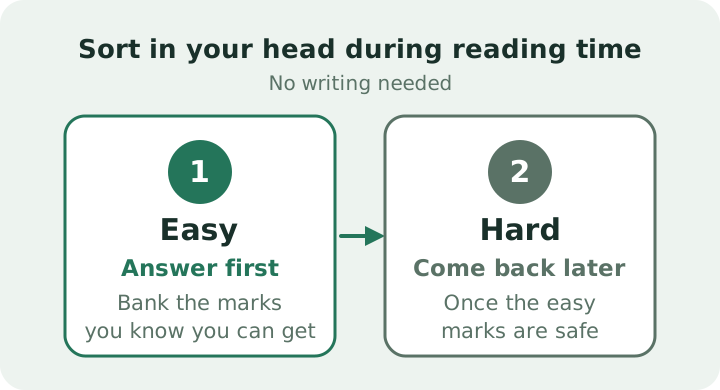
The fix: sort the questions into two buckets, in your head. You can't write during reading time, and you don't need to. As you read, just notice which questions feel easy and which feel hard.
- Easy: you recognise the concept straight away and know what you would write. The number of marks doesn't matter here; what matters is that you are confident you can get the marks.
- Hard: questions that make your stomach drop. Maybe you don't understand what is being asked at first glance, or it touches a topic you know is a gap. This can be a 2-marker just as easily as a long answer.
When writing time starts, answer all your easy questions first, then come back for the hard ones. There are two ways to do this:
- If many of your easy questions are in Section B, start with Section B straight away. There is no rule that says you have to go front to back.
- If your easy questions are spread across the paper, work through it in order but skip the ones that felt hard, then come back for them.
Your buckets will be different from your friend's, and that's the point. This is about your knowledge.
Why it works: it stops you getting stuck. Without a plan, it is easy to spend 15 minutes on one trick question and then not have that time for a question you actually knew. Easy questions first means you bank the marks you are sure of before you risk time on the rest.
Mistake 2: Not budgeting time per mark

Paper 2 at SL is 2 hours for 60 marks, which works out at about 2 minutes per mark. HL is 2 hours 30 minutes for 80 marks, so the same rule of thumb holds.
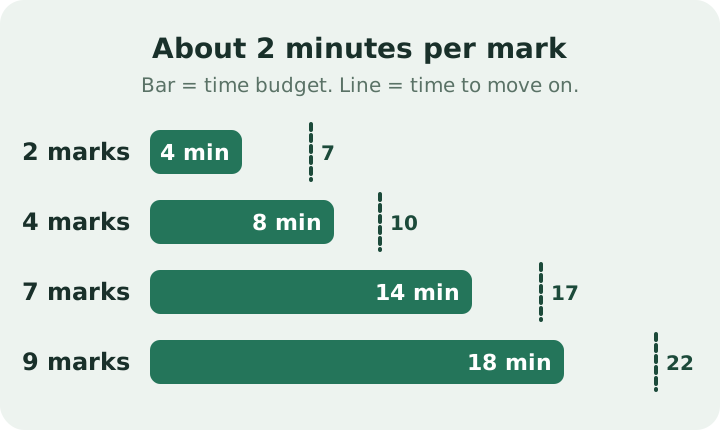
Plenty of questions won't need the full budget. A 4-marker you know well might take 4 minutes, which buys you time for the harder ones later. The budget is a guide, not a target.
Where it really matters is on the questions you find hard. If you have been on a 4-marker for more than 10 minutes, wrap up or move on. If you started with Section B and you have spent around 22 minutes on a 9-marker, it is time to write your conclusion. Give yourself a bit more leeway on the long answers, because planning takes time, but always keep an eye on the clock.
You won't have a stopwatch in the exam, so the skill is getting a feel for what 8 minutes or 18 minutes actually feels like. The fastest way to build that is to practise with a timer. The FirstHandIB practice questions have one built in, so you learn what "too long" feels like before it costs you the second half of Section B.
Mistake 3: Misreading the command term
The command term is the word at the start of the question that tells you what to do: state, outline, describe, explain, discuss, evaluate. Each one asks for something different, and the markscheme is built around it. If a question says "evaluate" and you only describe, you can know everything about the topic and still lose most of the marks.
Learning exactly what each command term asks for is one of the quickest ways to raise your score, because it has nothing to do with learning more content.
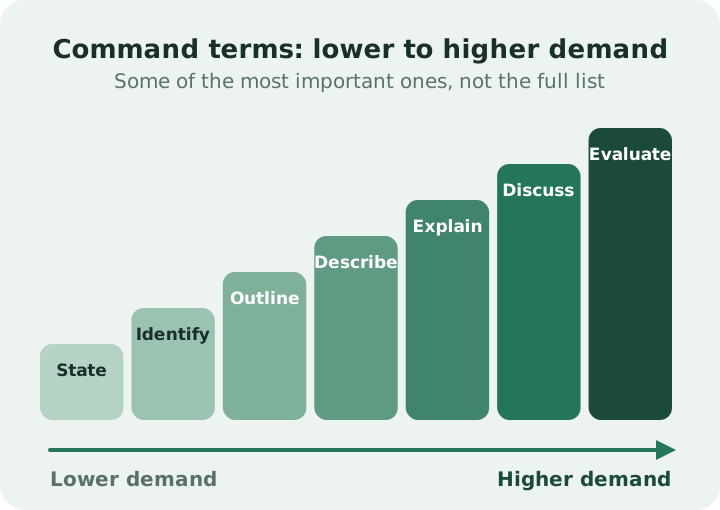
The command term students get wrong most: evaluate
The one students get wrong most is evaluate. Evaluate means weighing up strengths and limitations, then reaching a judgement. Most students write about the strengths only, or list both sides and stop without a conclusion.
Sample question
Weak answer (1 to 2 marks)
What went wrong: this is a description of how quotas work plus one strength. There are no limitations and no judgement, so it can't reach the top marks however accurate it is.
Strong answer (4 marks)
What made it work: two clear strengths, two clear limitations, and a final sentence that actually judges, including the conditions under which quotas work.
Command terms that get mixed up
- Outline
- A brief account: short, clear points without long explanations.
- Describe
- A detailed account: say what something is or looks like, with specifics such as figures or features.
- Explain
- A detailed account with reasons or causes: use "because" and "this leads to".
- Discuss
- A balanced review with a range of arguments, then a supported conclusion.
- Evaluate
- Weigh up strengths and limitations, then make a judgement.
- To what extent
- Take a position on how far you agree ("largely", "only partly") and justify it.
For the full list with examples for each, see my guide to ESS command terms.
Mistake 4: Reciting case studies instead of using them
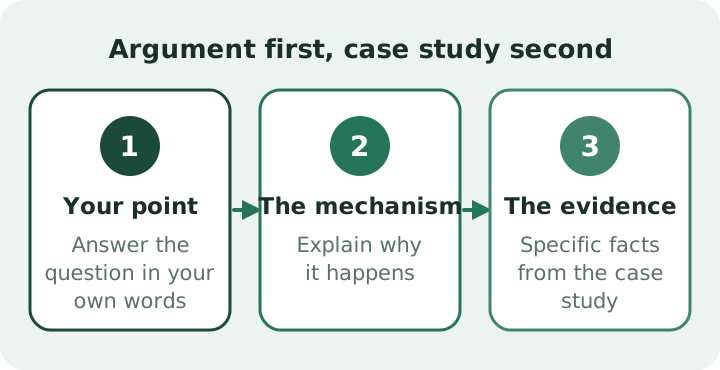
Examiners want named examples, so students memorise case studies. That's good. The problem is what happens next: many students write out the case study as if it makes the argument by itself. It doesn't. Your argument comes first, and the case study is the evidence that supports it.
Sample question
Weak answer (1 mark)
What went wrong: this shows you know an example of the tragedy of the commons, but it doesn't explain anything. There is no definition, no mechanism and no link between the example and the question. The case study is left to do all the work.
Strong answer (4 marks)
What made it work: both answers use the same case study. The difference is that the strong answer makes its own argument first (definition, then mechanism) and then uses specific facts from the case study, the 93% decline, the 1992 closure and the 30,000 lost jobs, to prove each step.
A rule to take into the exam: answer the question in your own words, then bring in the case study as support. That way you can't fall into the trap of showing off how well you memorised a case study without actually answering the question.
My case study repository lists, for every case study, which arguments it can support, so you know what to use it for before you walk in.
Mistake 5: Not rereading the question (and your answer)

This one is painful because it costs marks for no reason at all. So many students write a good answer to a question that wasn't asked: one reason when the question asked for two, causes when it asked for effects, or a general answer when it said "using an example".
The fix: read every question three times. Once when you sort it in reading time, once right before you answer it, and once at the end when you check your answer against it. Save the last 5 minutes of the exam for that final check.
Sample question
Weak answer (2 marks)
What went wrong: this is one way, explained well. The question asked for two, so half the marks were never available. A quick reread would have caught it.
Strong answer (4 marks)
Your last 5 minutes checklist
- Did I follow the command term? (Evaluate: strengths, limitations and a judgement.)
- Did I give the number of points asked for?
- Did I answer the exact thing asked, for example effects rather than causes?
- If it said "using an example", did I name one and link it to my argument?
- Did I include units and working on every calculation?
Bringing it together
None of these five fixes needs extra content. Sort your questions in reading time, keep to about 2 minutes per mark, answer the command term, make your own argument and use case studies to back it up, and reread before you hand in. Practise them on timed questions now, so they are automatic by exam day.
If you want to practise all five in one place, FirstHandIB has exam-style questions with a built-in timer, a markscheme checklist and sample answers for every question, plus a case study bank and a command terms guide. Try the first subtopic free.
FAQ
How long should I spend on each question in IB ESS Paper 2? About 2 minutes per mark at both SL and HL. That is around 8 minutes for a 4-mark question and around 18 minutes for a 9-mark question.
What should I do in the 5 minutes of reading time? Sort the questions into easy and hard in your head, then answer the easy ones first so you secure the marks you are confident about before spending time on the hard ones.
What does "evaluate" mean in IB ESS? Weigh up strengths and limitations, then make a judgement. Listing only advantages, or giving both sides without a conclusion, won't reach full marks.
How do I use case studies in IB ESS answers? Make your argument first in your own words, then use specific facts from the case study as evidence for each point. Don't let the case study stand in for the argument.